No Products in the Cart
We have been busy creating new products - Take a look here New Products


Warehouse safety topics should focus on controlling everyday hazards such as forklift traffic, blocked walkways, unstable storage, poor visibility, unsafe material handling, and unclear work zones. The most effective improvements are practical changes workers can immediately see and follow, including clearer floor markings, safer traffic routes, regular equipment checks, better housekeeping, and consistent training.
Warehouses combine pedestrians, powered industrial trucks, storage racks, loading docks, machinery, and repetitive material-handling tasks in the same environment. When these activities overlap without clear controls, a routine task can quickly create unnecessary risk.
This guide explains why common warehouse accidents happen, how straightforward changes can reduce exposure, and which improvements are most applicable to different areas of a facility. The goal is not to add unnecessary rules. It is to make safe movement, storage, equipment use, and communication easier to understand during a normal working shift.
Warehouse hazards rarely exist in isolation. A blind intersection becomes more dangerous when forklift traffic is heavy. Poor housekeeping becomes more serious when packaging or pallets extend into a pedestrian route. Manual lifting becomes more demanding when frequently handled products are stored too high, too low, or too far from the worker.
OSHA identifies powered industrial trucks, ergonomics, material handling, hazardous chemicals, slips, trips, falls, and other operational conditions among potential warehousing hazards. This makes hazard identification an important first step before choosing signs, markings, barriers, training, or other controls. Review OSHA warehousing hazards and solutions.
Forklifts are essential for moving materials, but the interaction between powered equipment and pedestrians requires careful control. Blind corners, loading docks, aisle intersections, rack ends, doorways, and staging areas deserve particular attention because workers and equipment may approach the same space from different directions.
A safer approach combines trained operators with an environment that clearly communicates where vehicles and pedestrians belong. Marked routes, appropriate signs, barriers where needed, intersection controls, good visibility, and established traffic procedures work together instead of relying on a single precaution.
Older warehouse safety resources also highlight the potential consequences of vehicle impacts and rack damage. Additional information about warehouse protection equipment is available from Atlantic Rack, while this resource discusses warehouse safety signs and labels.
When serious accidents and injuries occur and legal guidance is needed, affected workers and their families may also consult a personal injury lawyer to understand available legal options.
Not every serious warehouse hazard involves moving machinery. Loose packaging, damaged flooring, spills, cords, poorly positioned pallets, and materials extending into aisles can create everyday trip hazards. Elevated work adds another layer of risk when platforms, ladders, or other working surfaces are involved.
Good housekeeping is one of the simplest controls because it improves more than cleanliness. Clear aisles make floor markings easier to see, reduce obstructions around emergency routes, and help employees follow the intended traffic pattern.
Warehouse managers should also examine whether a recurring trip hazard points to a larger layout problem. If pallets continually end up inside a pedestrian path, repeatedly moving them may not solve the underlying shortage of staging space.
Warehouse employees frequently lift, carry, lower, push, pull, reach, and repeat movements throughout a shift. Repetitive or forceful material handling can become more difficult when products are positioned at awkward heights or workers repeatedly twist and reach.
Practical improvements include placing frequently handled products at accessible heights, reducing unnecessary reaching, using mechanical assistance when appropriate, reviewing repetitive tasks, and allowing enough room to handle products without awkward positioning.
The California Department of Public Health provides additional information about ergonomic hazards affecting warehouse workers in its warehouse worker guidance.
Choosing the right warehouse safety topics starts with the hazards employees actually encounter during normal operations. A distribution center with constant forklift movement may need to prioritize traffic separation, while a picking operation involving extensive manual handling may need to focus first on ergonomics, storage height, and safer material-handling methods.
A practical method is to consider how frequently employees encounter the hazard, how serious the potential outcome could be, and whether the proposed change actually reduces exposure.
| Warehouse Condition | Main Risk | Practical First Improvement |
|---|---|---|
| Forklifts and pedestrians share routes | Vehicle and pedestrian collision | Separate and clearly identify traffic paths |
| Materials extend into walkways | Trips and restricted movement | Improve storage and housekeeping |
| Blind intersections | Limited visibility | Add markings, signs, mirrors, or barriers as appropriate |
| Frequent manual lifting | Overexertion and ergonomic strain | Improve storage height and handling methods |
| Damaged racks or equipment | Equipment failure or unstable storage | Establish inspection and repair procedures |
| Poorly lit work areas | Reduced hazard visibility | Review lighting placement and illumination |
Among the most practical warehouse safety topics is facility layout because traffic flow, aisle organization, visibility, and storage placement directly affect how employees and equipment move through the building. Clear routes make safe movement easier to understand and reinforce throughout each shift.
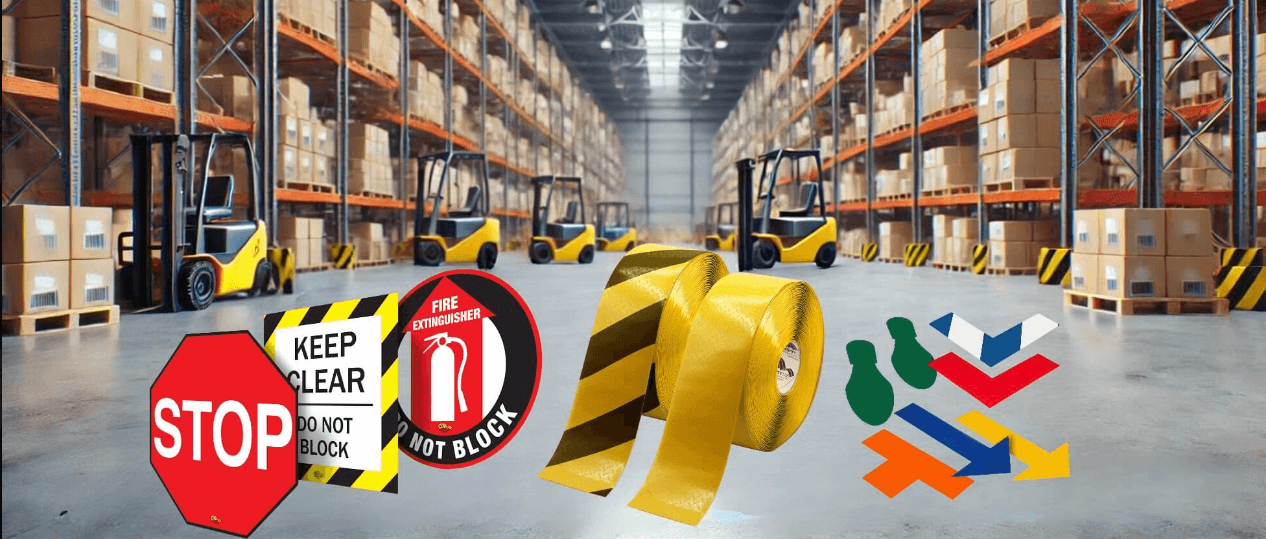
One practical improvement is separating pedestrian and powered-equipment traffic visually. Durable industrial safety floor tape, including Mighty Line floor tape, can help identify pedestrian paths, vehicle lanes, workstations, staging areas, and storage boundaries.
Floor marking tape and floor striping can reinforce a facility's traffic plan. Additional floor signs can communicate instructions at intersections, crossings, restricted locations, or other areas where a line alone may not provide enough information.
For additional layout considerations, see this guide covering effective warehouse layout design, along with information about warehouse floor marking and the impact of floor markings on pedestrian safety.
The best option depends on what the facility needs to communicate. Solid lines are useful for defining normal boundaries and traffic routes. Caution patterns can make selected hazard areas visually different, while floor signs can communicate specific instructions at the point where employees need them.
For general aisle and traffic-zone marking, solid industrial floor tape is usually the most broadly applicable option. It can define pedestrian paths, forklift routes, work cells, and storage boundaries. Caution safety floor tape is more appropriate when a location needs an additional visual warning.
Where workers need a specific instruction rather than only a boundary, Mighty Line standard floor signs can complement the tape system. This allows a facility to build a visual system in which lines define spaces and signs explain important actions.
Floor markings and signs become less useful when employees cannot clearly see them. Lighting should support visibility at intersections, loading docks, picking areas, stairs, storage aisles, and locations where pedestrians interact with powered equipment.
Mighty Line's article on warehouse safety by design provides additional planning context. Other resources discuss warehouse lighting and lighting best practices.
Lighting placement should minimize unnecessary shadows and glare while providing appropriate illumination for the task. Loading, picking, intersections, and storage areas may have different visibility requirements, so one lighting approach may not work equally well throughout the building.
Equipment maintenance is an important part of warehouse safety topics because damaged forklifts, racks, guards, ladders, dock equipment, and machinery can create hazards during routine operations. Equipment safety depends on more than repairing machinery after something fails. Routine inspections, preventive maintenance, guarding, and organized storage help identify problems before they interfere with normal operations.
Preventive maintenance should also be included when reviewing warehouse safety topics because equipment condition can change during daily operations. Scheduled inspections can help teams identify damaged racks, worn floor markings, malfunctioning equipment, and other issues before they contribute to a larger safety problem.
A practical inspection program establishes what needs to be checked, who is responsible, how frequently checks occur, and what happens when damage is discovered. Daily or scheduled inspections may cover forklifts, racks, guards, ladders, dock equipment, signs, floor markings, and facility-specific machinery.
Maintenance should be scheduled to reduce unnecessary disruption without allowing a known safety problem to remain unresolved. Additional perspectives are available in these resources on strategies for improving warehouse safety and warehouse maintenance.
Physical barriers and guards can separate employees from machinery or protect vulnerable warehouse infrastructure. The appropriate solution depends on the hazard and equipment involved.
Examples can include robot cell enclosures, conveyor guarding, end-of-aisle protection, rack protection, and column protection. Additional guidance about guarding is available in these warehouse OSHA guideline resources and this warehouse guards and railings guide.
Guards should not become substitutes for correcting poor traffic patterns. If forklifts repeatedly contact the same rack end or column, investigate why. The layout, visibility, turning clearance, or traffic route may also need attention.
Equipment should have designated storage locations that do not interfere with walkways, exits, vehicle lanes, or working areas. Shelving and storage systems should communicate applicable capacities, and workers need safe methods for storing and retrieving materials.
Additional organization ideas are available in this guide covering warehouse employee safety.
Regular training gives teams an opportunity to review warehouse safety topics that match current operations rather than relying only on general instructions. Briefings can focus on recent hazards, traffic changes, equipment procedures, housekeeping concerns, or other conditions employees are likely to encounter during their work.
A forklift briefing, for example, can address actual blind corners and pedestrian crossings inside the facility. A material-handling discussion can use products employees regularly move rather than relying entirely on generic examples.
Training may combine demonstrations, mentoring, group discussions, digital materials, and refresher sessions. Loss and incident trends can also help determine which subjects deserve additional attention. See this resource on warehouse safety culture and loss trend analysis.
Visual communication reinforces training during everyday work. Signs, floor markings, labels, and designated zones provide instructions where workers need them instead of requiring employees to remember every detail from a previous meeting.
Strategically placed floor signs can reinforce pedestrian crossings, stop locations, forklift traffic areas, and other facility-specific instructions.
Consistency matters. A color or symbol should not mean one thing in one aisle and something completely different elsewhere unless the distinction is clearly communicated.
Digital communication can complement physical signs. Electronic briefings and mobile systems may help employees access instructions and report hazards. See this resource about effective job safety briefings.
Regular refreshers can reinforce procedures as operations change. Additional guidance on building a warehouse safety culture and using warehouse communication systems can support this process.
When workplace incidents result in claims or disputes, businesses and employees may also need information concerning workers' compensation.
Traffic separation is one of the warehouse safety topics that benefits from strong visual communication. Clearly identified pedestrian walkways, forklift lanes, loading areas, storage zones, and restricted spaces help workers understand where they should move and where additional caution may be required.
| Safety Zone | What Should Be Clear | Useful Controls |
|---|---|---|
| Pedestrian walkway | Where employees should walk | Floor tape, signs, and barriers where appropriate |
| Forklift lane | Where powered equipment travels | Lane markings, intersection warnings, traffic procedures |
| Storage area | Where materials belong | Rack labels, clear aisles, defined staging limits |
| Loading dock | Vehicle and pedestrian boundaries | Traffic controls, edge protection, appropriate lighting |
| Restricted area | Who should enter | Signs, guarding, and controlled access |
| Emergency route | How workers leave safely | Visible exit signs and unobstructed passage |
Loading dock procedures are important warehouse safety topics because these areas bring pedestrians, forklifts, trucks, materials, and changing loads into a relatively concentrated space. Clear traffic rules, visible boundaries, appropriate lighting, and designated staging areas can make responsibilities easier for workers to recognize.
Physical controls may include dock barriers, vehicle restraints, edge protection, appropriate lighting, and clearly identified staging locations. More information is available from the Whole Building Design Guide loading dock resource, Inbound Logistics safety-zone guidance, and this guide covering loading dock safety design.
Storage areas should keep materials stable and prevent inventory from extending into active aisles. Frequently handled materials can also be positioned with ergonomics in mind so employees do not repeatedly perform difficult reaches or bends.
Where barriers are appropriate, this resource about effective safety barriers provides additional information. Facilities should also establish a method for reporting rack damage or unstable storage rather than allowing the condition to remain until the next scheduled inspection.
Battery charging areas require controls appropriate to the battery and equipment involved. Designated charging locations help separate charging activity from normal traffic while supporting appropriate ventilation, emergency equipment, and handling procedures.
Existing resources covering these considerations include information about forklift battery charging station safety requirements and forklift battery charging safety.
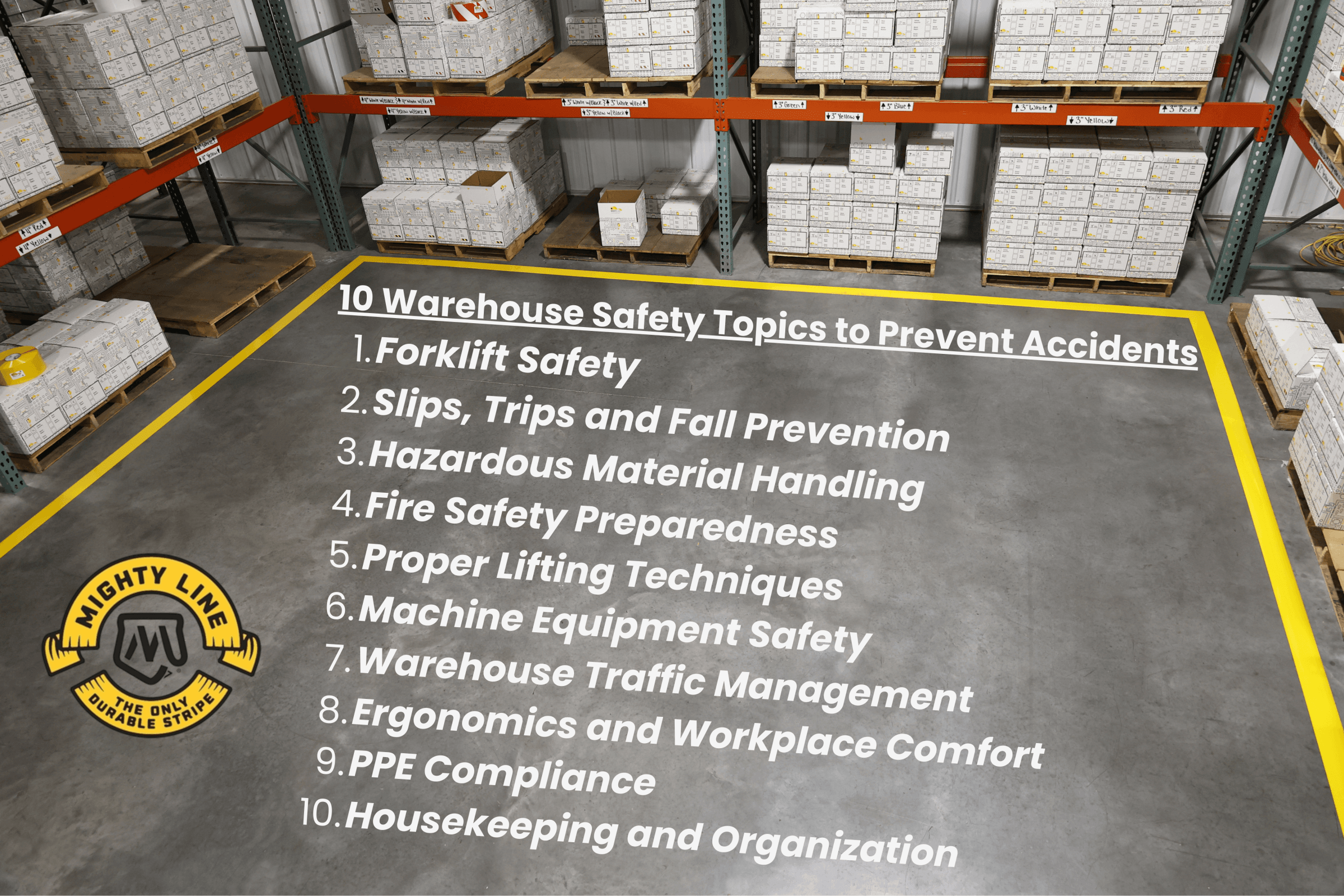
The following subjects work well for inspections, toolbox talks, refresher training, and routine meetings because each relates directly to conditions employees may encounter during a normal warehouse shift.
Train and authorize operators appropriately, maintain equipment, control speeds, and reinforce pedestrian awareness. Give additional attention to intersections, loading docks, blind corners, and reversing areas where visibility can change quickly.
Keep walkways clear, correct spills promptly, maintain walking surfaces, and prevent pallets, packaging, cords, tools, or equipment from obstructing designated pedestrian routes.
Use appropriate labels, storage methods, safety information, PPE, and spill-response procedures for substances handled at the facility. Employees should understand where relevant safety information and emergency resources are located.
Keep emergency routes and exits unobstructed, maintain required fire protection equipment, and ensure employees understand the facility's emergency procedures. Review plans when layouts, equipment, or operations change.
Review lifting tasks and reduce unnecessary force, reaching, twisting, or bending. Use mechanical assistance or team handling when appropriate and consider product placement when the same materials are handled repeatedly.
Inspect machinery, maintain guards, train employees on safe operation, and follow applicable lockout/tagout procedures when servicing or maintaining equipment.
Use clear warehouse floor markings to support designated pedestrian and vehicle routes. Reinforce the visual system with signs, controlled crossings, visibility measures, and traffic procedures.
Review workstation height, repetitive movements, product placement, reach distances, and tasks involving extended standing or awkward postures. Small changes to product location can sometimes remove repeated unnecessary movement.
Identify PPE appropriate to the hazards present, train employees on correct use, and inspect or replace damaged equipment when necessary. PPE should support other controls rather than becoming the only response to a preventable hazard.
Keep work areas organized and ensure tools, pallets, packaging, and materials do not create unnecessary obstructions. Approaches such as 5S can also help facilities establish a more consistent visual organization system.
For more recurring meeting ideas, explore Mighty Line's safety talk and toolbox talk resources and additional articles from Warehouse Safety Tips.
You can also find short safety-focused content at MightyLineMinute.com.
Trying to correct every issue at once can make a safety program difficult to manage. A more practical approach is to inspect the facility during normal operations, identify significant exposures, prioritize corrections, and verify whether the changes actually work.
Watch where employees really walk rather than where the original floor plan says they should walk. Observe where forklifts turn and reverse. Check whether temporary staging blocks visibility or pushes employees outside designated routes. Look for damaged markings, rack impacts, poor lighting, awkward lifting, and areas where the intended layout is routinely ignored.
Then ask a simple question: Why is this unsafe behavior or condition occurring?
If employees repeatedly take a shortcut across a forklift lane, another warning sign may not solve the problem. The designated pedestrian route may be poorly positioned. If pallets repeatedly extend into a walkway, the staging area may not provide enough usable space.
This distinction matters because correcting the cause is generally more useful than repeatedly correcting the symptom. Employee feedback can also reveal problems that are difficult to identify during a scheduled management walkthrough.
Effective improvements do not have to begin with expensive renovations. Clear caution safety floor tape, durable solid industrial floor tape, appropriate floor signs, organized storage, better lighting, equipment maintenance, and practical training can all contribute to a safer and easier-to-understand workplace.
The best option depends on the hazard. Traffic separation is particularly applicable where pedestrians and forklifts interact. Better storage and housekeeping become priorities when materials interfere with aisles. Ergonomic changes matter where employees repeatedly lift and handle products. Equipment inspections are essential wherever damaged machinery or storage systems could expose workers to additional risk.
Safety also requires follow-through. Conditions change as inventory, equipment, employees, and workflows change. Regular walkthroughs and employee feedback help determine whether existing controls still make sense.
Small improvements become meaningful when employees can see them, understand them, and use them consistently throughout the workday. Reviewing warehouse safety topics during inspections, toolbox talks, and refresher training can help teams keep attention on changing hazards instead of treating safety as a one-time project.
The most useful warehouse safety topics are the ones connected to conditions employees actually face. Reviewing incident trends, employee feedback, equipment changes, traffic patterns, and facility layouts can help managers decide which hazards need attention first and which controls are most appropriate.
[1] Atlantic Rack: Warehouse Safety and Protection Equipment
[2] DLS: Warehouse Safety Signs and Labels
[3] OSHA: Warehousing Hazards and Solutions
[4] Global Industrial: Warehouse Safety Guide
[5] Inbound Logistics: Warehousing the Safety Zone
[6] OSHA Standard 1926.441
[7] California Department of Public Health: Warehouse Worker Guidance
[8] Occupational Health & Safety: Warehouse Layout Design
[9] Painters Inc.: Warehouse Floor Marking Guide
[10] Serviap Logistics: Warehouse Floor Markings
[11] HCO Innovations: Floor Markings and Pedestrian Safety
[12] Mighty Line: Warehouse Safety by Design
[13] Interlake Mecalux: Warehouse Lighting
[14] EC&M: Warehouse Lighting Best Practices
[15] RFgen: Strategies for Maximizing Warehouse Safety
[16] ShipBob: Warehouse Maintenance
The most important areas usually include forklift traffic, pedestrian safety, slips and falls, material handling, storage, ergonomics, equipment safety, fire protection, and emergency procedures.The priority should still reflect conditions inside the individual facility. A warehouse with heavy forklift traffic may need to address vehicle and pedestrian separation first, while a manual picking operation may benefit more immediately from ergonomic improvements, accessible product placement, and improved handling procedures.
Floor markings help workers quickly recognize pedestrian routes, forklift lanes, storage areas, work zones, crossings, and other designated spaces. A consistent system reduces uncertainty about where people and equipment should move. Products such as industrial safety floor tape can support a traffic plan, but markings work best when combined with employee training, housekeeping, appropriate signs, barriers where needed, and safe operating procedures.
Inspection frequency should match the hazard, equipment, applicable requirements, and how quickly conditions can change.
Some equipment may require checks before use, while broader facility inspections can follow a documented schedule. High-traffic locations may need more frequent observation because spills, damaged markings, misplaced pallets, rack impacts, or blocked walkways can develop during a single shift. Findings should be documented, corrected, and reviewed to confirm that corrective action was effective.
The best approach is to identify the actual hazard and combine controls that reduce exposure rather than relying on one safety measure. Forklift risks may require trained operators, pedestrian separation, marked routes, controlled crossings, visibility improvements, and barriers in selected areas.
Manual-handling risks may require better product placement or mechanical assistance. The most applicable solution addresses how work is actually performed inside the facility rather than applying exactly the same control everywhere.