No Products in the Cart
We have been busy creating new products - Take a look here New Products

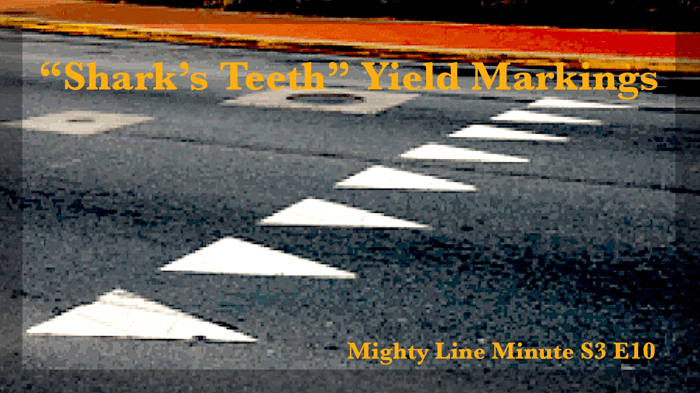

Greetings, everyone, and welcome to our Blog inspired by Dave at Mighty Line Minute—where everyday roadway details reveal important stories about safety, engineering, and awareness. If you’ve ever driven through Westlake, Ohio, particularly along roads like Hilliard, Clague, or Bradley, you may have noticed a pattern of white triangles painted across the pavement as you approach certain pedestrian crossings. These markings, often referred to as “shark’s teeth,” are more than just visual curiosities—they are a carefully designed safety feature rooted in decades of traffic engineering evolution.
A European Innovation with Global Impact
The origin of shark’s teeth markings can be traced back to the Netherlands, a country long recognized for its progressive and safety-conscious approach to transportation design. Dutch engineers pioneered these triangular markings as a way to create a clear, universally understandable visual cue for drivers. Over time, the effectiveness of this design led to its adoption across Europe, and eventually, in the United States and other parts of the world.
Interestingly, while the fundamental concept remains the same, the orientation of the triangles varies by region. In the United States, the point of each triangle faces the oncoming driver, reinforcing the idea that the driver must yield. In contrast, in the United Kingdom and parts of Europe, the triangles are inverted, with the point facing toward the crosswalk or pedestrian zone. Despite this difference, the message remains consistent: slow down, stay alert, and be prepared to stop.
The Science Behind the Design
Traffic markings are not arbitrary; they are guided by rigorous standards and research. The U.S. Department of Transportation recommends that these triangular markings maintain a specific proportion—typically a 1 to 1.5 ratio between the base and the height of the triangle. This ensures optimal visibility and recognition at various speeds and distances.
Placement is equally important. Shark’s teeth are positioned upstream of the crosswalk, giving drivers advance notice before they reach the pedestrian zone. This buffer space allows for safer stopping distances and reduces the likelihood of abrupt braking, which can lead to collisions.
These markings are often used in conjunction with other visual cues, such as “zebra crosswalks”—the familiar parallel white bars that gained cultural recognition from The Beatles’ iconic Abbey Road album cover. Together, these elements create a layered system of communication between the roadway and the driver.
Why Advance Yield Markings Matter
The primary goal of shark’s teeth markings is to enhance pedestrian safety. Unlike signalized intersections, where traffic lights dictate movement, unsignalized crosswalks rely heavily on driver awareness and compliance. This is where advance yield markings play a crucial role.
By alerting drivers earlier than a standard crosswalk alone would, these markings reduce the risk of a phenomenon known as “multiple threat crashes.” This occurs when one vehicle stops for a pedestrian, but another vehicle in an adjacent lane continues forward, potentially striking the pedestrian. The presence of shark’s teeth encourages all drivers to anticipate the possibility of a pedestrian crossing, even if their immediate lane appears clear.
Additionally, these markings are increasingly being used near roundabouts and traffic circles, where the flow of traffic is continuous and traditional stop controls are absent. In such environments, clear visual communication is essential to maintaining both efficiency and safety.
A Growing Presence in American Communities
In recent years, communities across the United States have begun to adopt shark’s teeth markings more widely. Cities and suburbs alike are recognizing the value of these simple yet effective designs. In many communities, their installation reflects a broader commitment to pedestrian safety and modern traffic engineering practices.
Local public service departments and community engineers deserve recognition for implementing and maintaining these markings. Their work often goes unnoticed, yet it plays a vital role in protecting both drivers and pedestrians.
As urban and suburban areas continue to grow, so too does the complexity of traffic patterns. Increased congestion, a rise in new drivers, and a greater emphasis on walkability all contribute to the need for clearer, more effective roadway communication. Shark’s teeth markings are one piece of this evolving puzzle.
Awareness: The Key to Safety
While engineering solutions like advance yield markings are essential, their effectiveness ultimately depends on public awareness. Drivers must understand what these markings mean and how to respond to them. Likewise, pedestrians benefit from recognizing these cues as indicators of safer crossing zones.
Education is critical. Whether through driver’s education programs, public awareness campaigns, or resources like Mighty Line Minute, spreading knowledge about roadway markings can lead to safer behavior on all sides.
When approaching shark’s teeth markings, drivers should slow down, scan for pedestrians, and be prepared to yield. This is especially important in areas where visibility may be limited or where pedestrians may enter the crosswalk unexpectedly.
The Bigger Picture
Yield markings such as these are a small but powerful example of how thoughtful design can influence behavior and improve safety. They represent a blend of international innovation, scientific research, and local implementation—all working together to create safer roadways.
As we continue to modernize our infrastructure, it’s important to recognize and appreciate these details. They are not simply paint on pavement; they are carefully engineered tools designed to save lives.
Final Thoughts
The next time you find yourself driving through a community that has adopted these markings—take a moment to notice these “give-way” yield markings on the road ahead. They are a reminder that safety is a shared responsibility, supported by both smart design and informed behavior.
Additionally, consider applying triangular shark’s teeth markings in warehouse and industrial environments by combining them with zebra crosswalks. Many of our European customers already use 10-inch-wide Mighty Line floor tape, along with 6-inch-wide white “stop bars,” to achieve these EU-style designs and patterns. Standard “continental crosswalks” can also be created using Mighty Line’s white 50-mil floor tape. And – if you have a special design need –don’t hesitate to reach out to our team directly for help.
So, remember: give way, stay alert, and always be prepared to stop for pedestrians at all crosswalks. Awareness isn’t just helpful—it’s essential.
Thanks for reading, and we’ll see you again soon – here – or over at Mighty Line Minute!