No Products in the Cart
We have been busy creating new products - Take a look here New Products

Anticipation, Automation, & Ambition: The Bassett Spring Co. Story
As the year draws to a close, anticipation seems to surface everywhere—on factory floors, in offices, and around kitchen tables. It’s present in the quiet moments when we reflect on the choices we’ve made, the risks we’ve taken, and the responsibilities we carry for the people who depend on us. It’s also a time to look ahead, especially when it comes to safety, opportunity, and the future we’re building.
To understand how anticipation, automation, and ambition can intersect in powerful ways, we’re going back more than seventy years—to February 1951—and to a busy factory floor on Athens Avenue in Lakewood, Ohio.
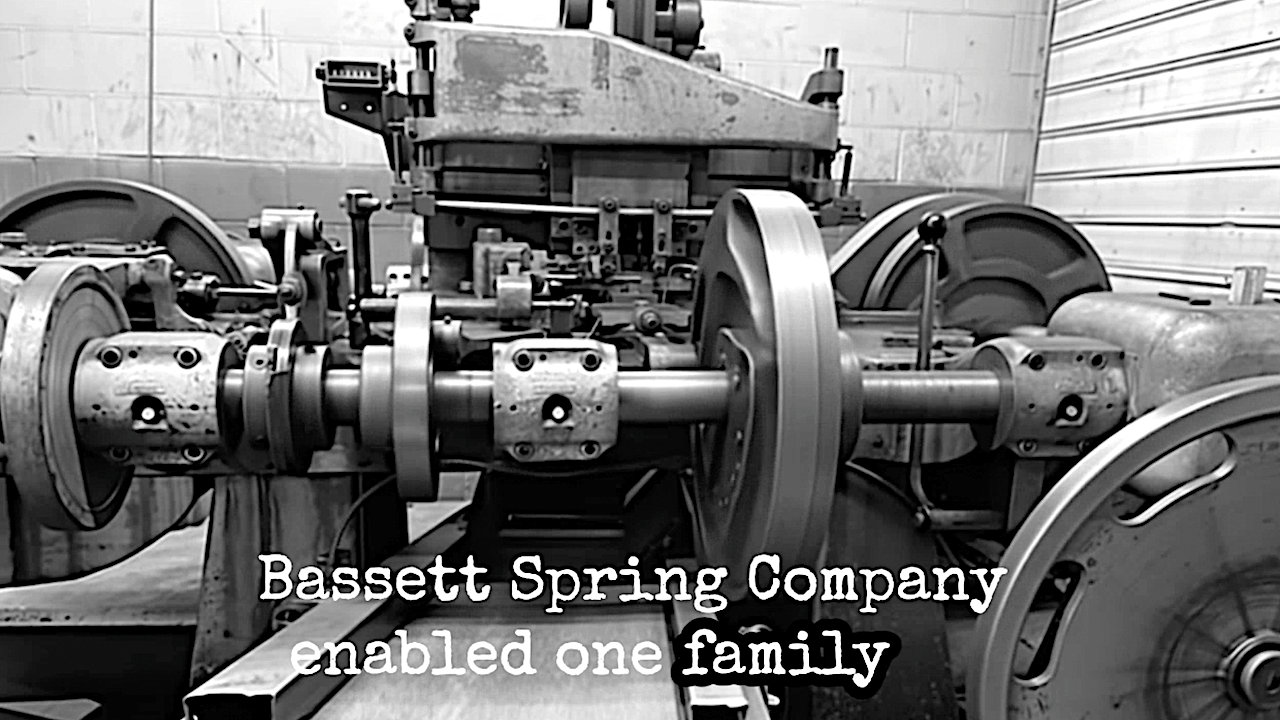
To appreciate what made this shop unique, it helps to first understand the machines that powered it.
Four-slide—also known as multi-slide—forming machines emerged in the early 20th century as a breakthrough in manufacturing efficiency. These machines were designed to produce small metal components by feeding, bending, stamping, and shaping wire or strip material in one continuous process. Compared to earlier methods, four-slide machines dramatically improved both speed and accuracy, allowing manufacturers to produce consistent, high-quality parts at scale.
The first true four-slide machines were engineered and manufactured in Connecticut—specifically in industrial centers like Waterbury, Bridgeport, and Bristol. These towns were hotbeds of innovation, supplying machinery that would soon find its way across the country as demand for springs, clips, and precision wire forms grew—especially in automotive, appliance, and defense manufacturing.
A Garage, a Vision, and an Early Bet on Automation
William Henry Bassett was among the early adopters who recognized the potential of four-slide technology. Long before Bassett Spring Company occupied a factory floor in Ohio, the business began humbly—in William Henry Bassett’s garage in New Haven, Connecticut.
This wasn’t just a side operation. It was a calculated bet on automation at a time when many manufacturers were still relying on slower, labor-intensive methods. That included the slower, single-stroke presses that were otherwise very common in machine shops throughout the country. By investing in four-slide machines early, Bassett positioned himself ahead of the curve, anticipating a future where precision, repeatability, and efficiency would define successful manufacturing.
As demand grew and Connecticut manufacturers began selling and relocating equipment nationwide, opportunity followed.
Moving West: The Birth of a Lakewood Factory
In the 1930s, William H. and Stella M. Bassett relocated from New Haven to Ohio’s Western Reserve, bringing their four-slide machines with them. Those machines—already proven and reliable—became the backbone of a small but capable factory in Lakewood, Ohio.
That factory, located at 13000 Athens Avenue, would later be known as part of what many locals remember as the Screw Factory. But at the time, it was simply a shop filled with innovation, energy, and the constant rhythm of automated machinery.
From this location, Bassett Spring Company supported America’s industrial needs through World War II. Like many small manufacturers, the company contributed to the war effort, producing essential wire-formed components while family members served overseas.
When the war ended and their sons returned from service, the business didn’t slow down—it grew.
A Tireless Leader on the Factory Floor
By the mid-1940s, Bassett Spring Company was humming. And at its center was a woman whose presence filled the shop.
In February 1951, The Cleveland Press published a profile titled “Tireless Grandma Runs Wire Firm.” The article spotlighted Stella Bassett—company president, trained nurse, mother of five, and grandmother—who led the business with confidence, technical knowledge, and relentless energy.
Stella knew every machine on the floor. If you walked into the shop, you’d hear the rhythmic chatter of automatic four-slide machines turning out hundreds of metal and wire clips. And Stella could hear more than just noise—she could hear meaning.
When a machine’s tone changed, she knew immediately what it meant.
“They’ve just started the new job,” she’d say, lighting up with excitement.
From its shop on Athens Avenue, Bassett Spring Company produced nearly 400 varieties of clips and wire-formed parts, supplying a wide range of industries that relied on precision and consistency.
Building for the Next Generation
What made Bassett Spring Company special wasn’t just its output—it was Stella herself.
In the newspaper profile, she explained that her goal was to build the business for her sons, who at the time were scattered across work, college, and the Army. Her daughters were pursuing nursing and education. Until the next generation was ready, Stella took it upon herself to move the company forward.
She had recently expanded the shop by 20% and invested in new equipment expected to increase production by 25%—a significant commitment that reflected both confidence and foresight. And while she was capable of running every machine herself, Stella never claimed to do it alone.
She relied on a crew of twelve skilled workers, whom she proudly referred to not as employees, but as friends.
Anticipation as a Leadership Skill
At a time when women industrial leaders were rare—especially in manufacturing—Stella Bassett wasn’t asking for permission. She was already doing the work: leading, organizing, expanding, and building a business with the same steady rhythm as the machines she listened to so closely.
Her true strength wasn’t just technical skill or work ethic. It was anticipation.
She could look ahead, recognize opportunity, and envision what the future could become—for her company, her family, and the people who relied on her leadership.
A Legacy Built on Vision
That’s the story of Bassett Spring Company—one of the early industrial forces inside the building we now know as Lakewood’s Screw Factory. It’s a reminder that progress often begins with someone willing to invest early, listen carefully, and act decisively.
Automation made the work possible. Ambition made it grow. But anticipation made it endure.
As we reflect on our own work and the choices ahead—especially when it comes to safety, innovation, and responsibility—there’s something to learn from that factory floor on Athens Avenue.
Have a safe and productive day, and take time to anticipate future opportunities—for yourself, your family and friends, and for others as well.
Cheers!