No Products in the Cart
We have been busy creating new products - Take a look here New Products


Color is one of the most immediate and recognizable forms of communication in the workplace, and ANSI Z535 is a big part of that. Before an employee reads a warning, studies a safety sign, or identifies a particular hazard, color can provide an important visual cue about the conditions ahead. In industrial facilities, manufacturing plants, distribution centers, and warehouses, the consistent use of safety colors helps employees recognize potential hazards, identify safety equipment, and navigate their surroundings more effectively.
Understanding these standards is important for environmental health and safety (EHS) professionals, engineers, facility managers, and warehouse operators responsible for developing and maintaining effective workplace safety programs.
The ANSI Z535 series consists of several complementary standards addressing different aspects of safety communication:
The series provides a coordinated approach to safety communication, helping organizations use consistent colors, symbols, signs, and messages to communicate hazards and necessary precautions.
The ANSI Z535 series has also expanded to include ANSI Z535.7, which addresses product safety information in electronic media. Together, these standards reflect the growing importance of consistent safety communication across both physical and digital environments.
Although ANSI standards are voluntary consensus standards, their relationship with OSHA regulations is important.
OSHA's general industry standards include requirements for safety colors, accident prevention signs, and hazard identification. For example, 29 CFR 1910.144 addresses the safety color code for marking physical hazards, while 29 CFR 1910.145 addresses specifications for accident prevention signs and tags.
Historically, OSHA incorporated earlier ANSI safety color and signage standards by reference. Subsequent regulatory updates provided employers with the option of following certain newer ANSI standards, including ANSI Z535.1-2006 (R2011), Z535.2-2011, and Z535.5-2011, as alternatives to specified older editions.
It is important, however, to distinguish those OSHA-recognized editions from the latest publications. The 2022 edition of ANSI Z535.1 is a newer voluntary consensus standard, but its publication does not automatically replace the editions specifically incorporated by reference in OSHA regulations.
Employers should therefore review the applicable OSHA requirements and determine whether newer consensus standards provide an appropriate and equally protective approach. OSHA has recognized that compliance with an applicable proposed or consensus standard that clearly provides equal or greater employee protection may be treated as a de minimis condition in certain enforcement circumstances. This is not a blanket exemption from OSHA requirements.
For organizations developing or updating their safety programs, the practical objective should be to maintain compliance while incorporating current, technically sound safety practices.
ANSI Z535.1 establishes technical specifications for safety colors, including their color characteristics and acceptable tolerances. The 2022 edition also addresses the relationship between ANSI and ISO safety colors.
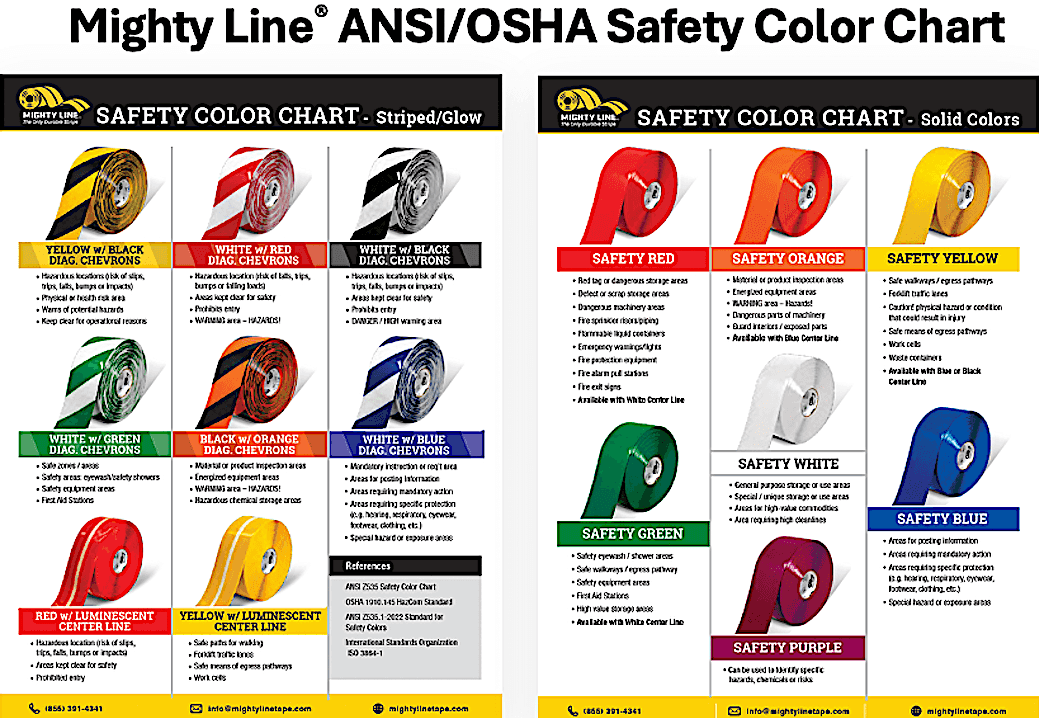
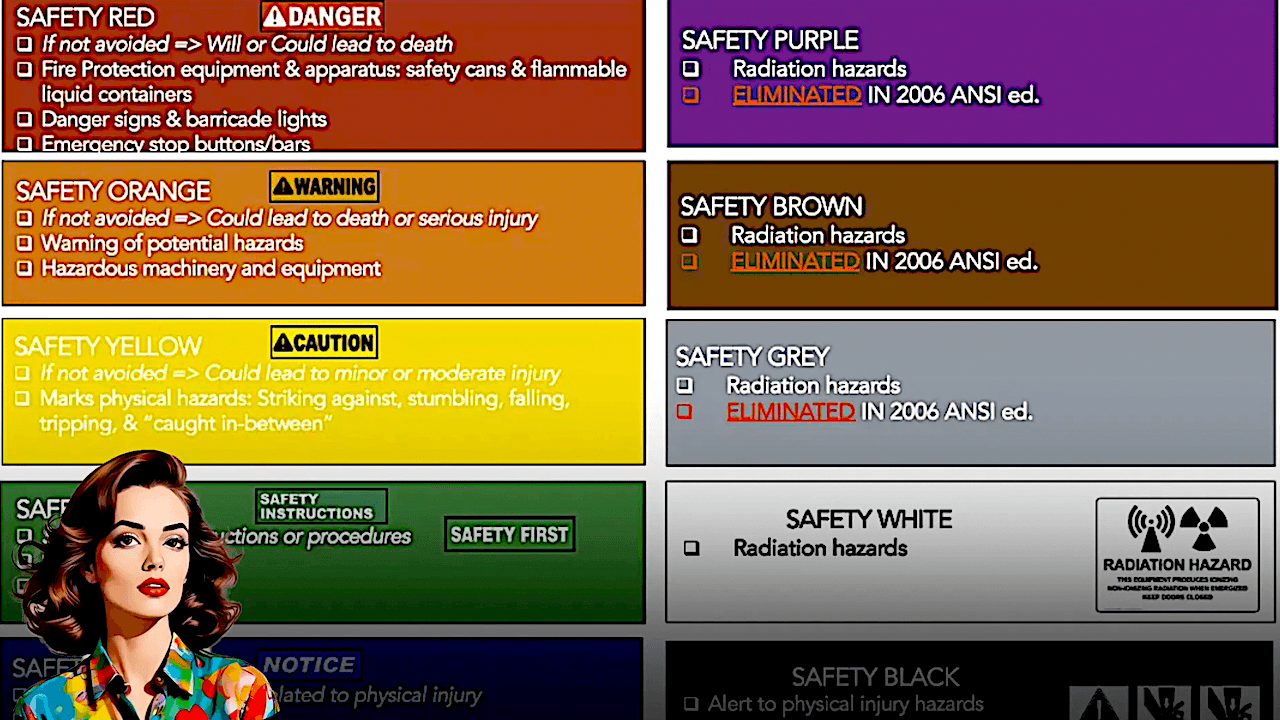
The principal colors used in safety communication include:
1. Safety Red
Red is commonly associated with immediate danger, stopping, and emergency equipment. In industrial environments, red is frequently used to identify fire protection equipment, fire extinguishers, emergency stops, and other critical safety devices.
Red floor markings or tape may also be used to identify areas that must remain clear for fire protection equipment or other emergency access requirements.
2. Safety Orange
Orange identifies warning conditions associated with hazardous machine parts and other potential hazards that could result in serious injury. It is particularly useful around exposed machinery, pinch points, and equipment presenting mechanical hazards.
3. Safety Yellow
Yellow is commonly associated with caution and physical hazards requiring attention. Examples include areas presenting tripping, slipping, falling, or collision hazards.
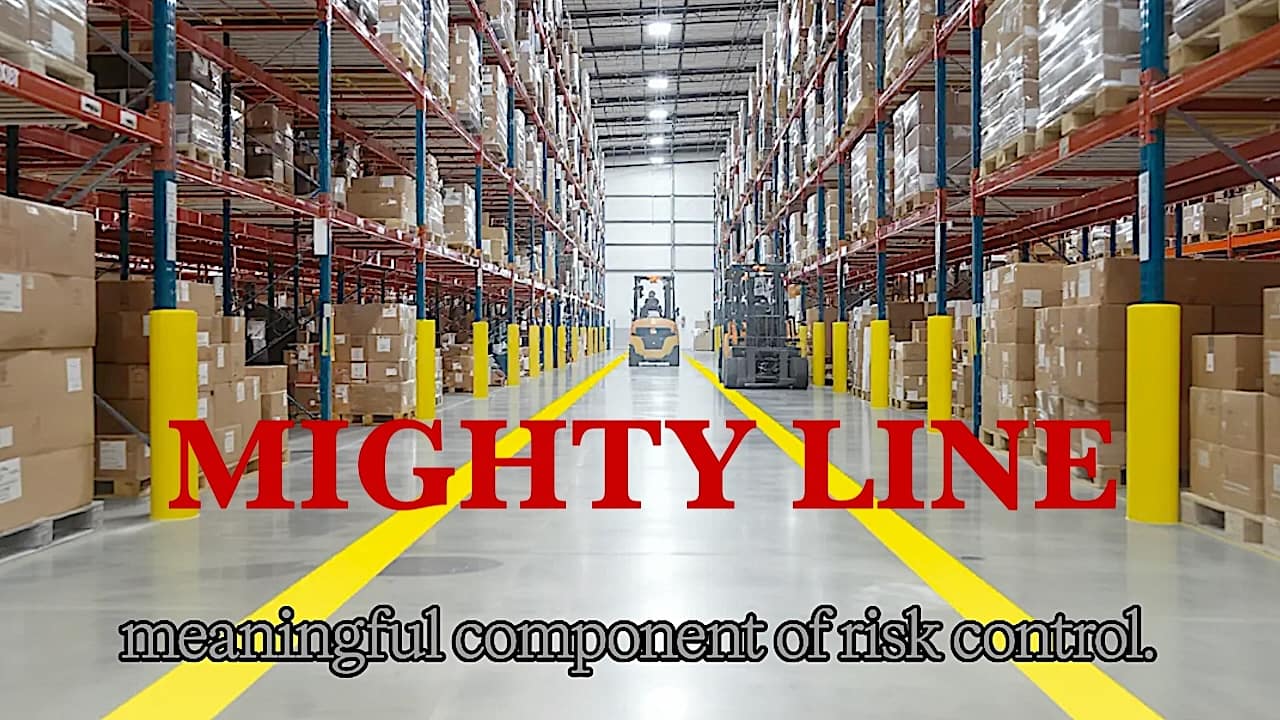
In warehouses, yellow is frequently used for floor markings, aisle boundaries, pedestrian walkways, and other areas where employees need to recognize potential hazards or changes in traffic patterns.
4. Safety Green
Green is generally associated with safety instructions, safety equipment, and the location of safety-related resources.
Examples include first-aid supplies, emergency eyewash stations, and other safety equipment or information areas. Green can also be incorporated into facility identification systems for designated storage or operational areas, provided the organization establishes and consistently communicates its intended meaning.
5. Safety Blue
Blue is commonly used for informational or cautionary notices, particularly where specific instructions or precautions are necessary. It is frequently associated with mandatory actions, including requirements to wear personal protective equipment (PPE).
6. Safety Purple
Purple is associated with radiation hazards and is used in conjunction with the appropriate warning symbols and messages to identify radiation-related risks.
7. Safety White
White is commonly used as a background or contrast color in safety signage and facility markings. In industrial settings, white may also be incorporated into floor-marking systems to identify designated areas, equipment locations, or traffic boundaries.
Black is also important within the ANSI safety color system, particularly as a contrast color and in combination with other colors.
It is important to remember that the colors themselves are only part of an effective safety communication system. Their application, accompanying messages, symbols, and consistency throughout the workplace are equally important.
One of the most practical applications of ANSI safety colors is industrial floor marking.
In warehouses and manufacturing facilities, floor markings provide employees with immediate visual information about pedestrian pathways, forklift traffic, work areas, storage locations, and potential hazards. Properly selected and maintained markings can help reduce confusion, improve material-handling operations, and reinforce established safety procedures.
For example, red floor tape or markings can identify areas associated with fire protection equipment, emergency access, or other designated safety requirements. Yellow or white markings may be used to identify aisleways, pedestrian walkways, vehicle lanes, and other designated traffic areas.
Yellow-and-black diagonal markings can also draw attention to unusual physical hazards, obstructions, or areas requiring additional caution.
Green markings may be incorporated into a facility's identification system for safety equipment and designated operational areas.
However, it is important to recognize that ANSI Z535.1 establishes color specifications rather than a universal floor-marking color assignment for every warehouse or manufacturing operation. OSHA requirements, other applicable standards, and the facility's documented marking program should determine how individual colors are applied.
Organizations should also consider the durability, visibility, and condition of their floor markings. Faded paint, damaged tape, inconsistent colors, and poorly maintained signage can undermine even the most carefully developed safety program.
Establishing a color-coding system is only the beginning. Employees must understand what the colors mean and how they relate to the hazards and operational requirements within their workplace.
For EHS professionals and facility managers, this means developing a consistent approach to safety signage, floor marking, equipment identification, and hazard communication. Employees should receive appropriate training during onboarding and whenever significant changes are made to facility layouts, traffic patterns, or safety procedures.
Periodic inspections are equally important. Floor markings and signs should be evaluated for visibility, placement, physical condition, and consistency with the organization's safety program. Ultimately, safety colors are most effective when employees recognize them immediately and understand the appropriate response.
ANSI Z535.1 also has an important relationship with international safety color standards. Specifically, the 2022 edition harmonizes with ISO 3864-4, which addresses the colorimetric and photometric properties of safety colors. This relationship is particularly relevant to organizations operating internationally or working with products and materials used across different markets.
In our next discussion, we'll take a closer look at the ISO safety color standard and how it relates to ANSI, including the importance of consistent color specifications in workplace safety applications.
For now, remember that whether you're identifying an immediate hazard with red, marking a pedestrian walkway with yellow or white, or identifying safety equipment with green, the objective is the same: provide employees with clear, recognizable visual information that helps them make safer decisions.
Make sure your facility's floor striping, floor marking, signage, and other safety communication systems are consistent with applicable standards and requirements. Just as importantly, make sure your employees understand what those colors mean. Because effective safety communication begins with recognition, understanding, and action.