No Products in the Cart
We have been busy creating new products - Take a look here New Products

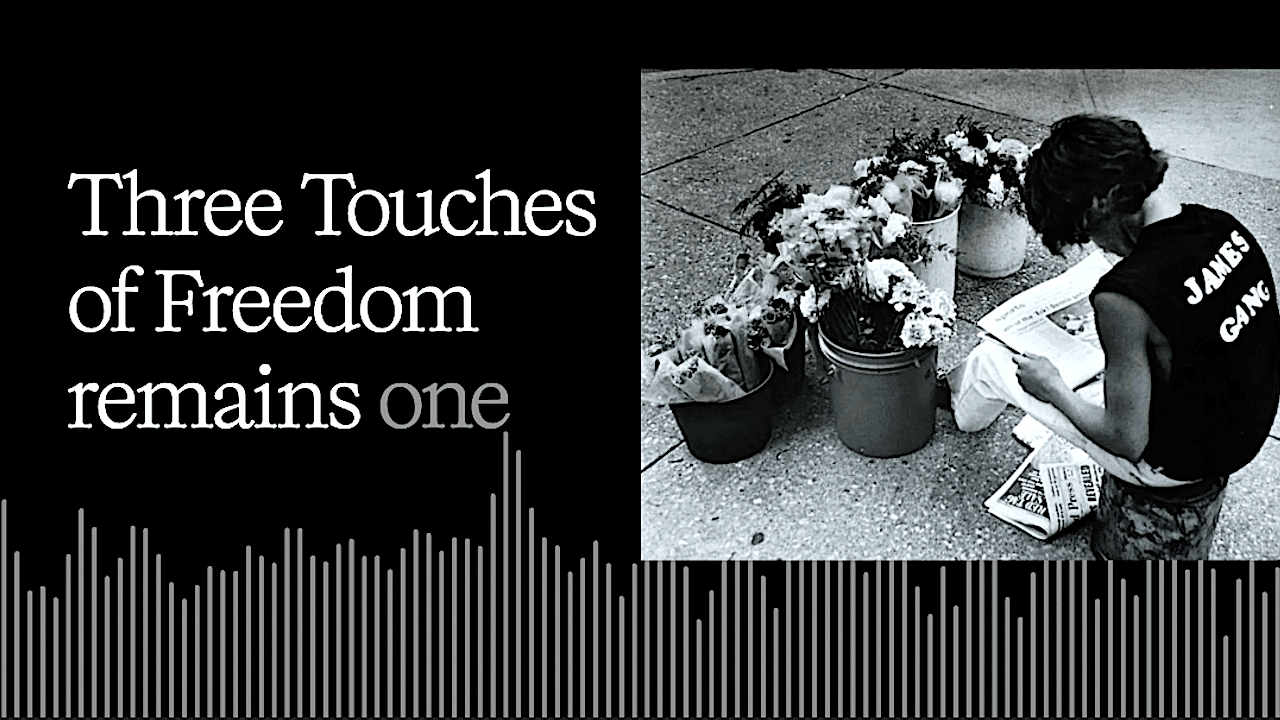
Every Independence Day, Americans celebrate the ideals that have shaped the nation for nearly two and a half centuries. Fireworks illuminate the sky, flags wave proudly, and communities gather to remember the Declaration of Independence and the freedoms it proclaimed. Yet sometimes the deepest expressions of patriotism are found not in grand ceremonies, but in quiet, everyday moments that remind us what freedom truly looks like. So, what is "3 Touches of Freedom?"
One remarkable photograph captures that spirit perfectly.
A Photograph That Captured America
The photograph itself appears wonderfully ordinary at first glance.
Children are playing outdoors on a sunny day. One young boy leaps into the air with unmistakable excitement, stretching his hand toward a large American flag billowing above him. Behind the children stands a transport truck, while a church quietly anchors the background.
William Wynne recognized something extraordinary within this spontaneous scene.
To him, the waving American flag represented freedom of expression. The truck symbolized freedom of enterprise—the ability of Americans to work, build businesses, and pursue opportunity. The church reflected freedom of religion, one of the nation's most cherished constitutional protections.
Nothing in the image appears staged. The boy's joyful leap happened naturally as Wynne instinctively pressed the shutter at precisely the right moment. Great photographers often speak about anticipation rather than luck, and Wynne possessed an exceptional ability to recognize meaningful moments before they disappeared.
The resulting image became known as "Three Touches of Freedom," not simply because of what appears within the frame, but because of what the photograph invites viewers to see beyond it.
National Recognition
The image quickly attracted attention.
During the 196a0s, the Freedoms Foundation at Valley Forge honored Wynne with its prestigious George Washington Honor Medal, one of the organization's highest recognitions for advancing patriotism, civic responsibility, and appreciation for the American way of life.
The photograph also earned significant professional recognition closer to home, receiving honors from the Newspaper Guild, including Best Picture and Photo of the Year.
Today, the original photograph is preserved within the William A. Wynne Photography Collection at Cleveland State University's Michael Schwartz Library Special Collections, ensuring that future generations can continue to experience its historical and artistic significance. Many of Wynne's early newspaper photographs have also been preserved through the Cleveland Memory Project, providing an invaluable visual record of Northeast Ohio during the mid-twentieth century.
From War to Journalism
By 1953, William Wynne had joined The Cleveland Plain Dealer as a full-time staff photographer, but his remarkable career had already taken him around the world.
During World War II, Wynne served as a corporal with the 26th Photo Reconnaissance Squadron in the Pacific Theater. His assignment required precision, courage, and technical expertise. Flying dangerous reconnaissance missions, military photographers documented enemy positions and gathered intelligence that supported combat operations.
Photography during wartime was far more than journalism. It became a strategic military tool that helped commanders make critical battlefield decisions.
Wynne understood both the technical demands of aerial photography and the human realities of war. His experiences would shape the compassion and authenticity that later defined his civilian work.
Smoky: The Little Dog Who Became a Legend
While serving overseas, William Wynne became forever associated with one of the most beloved animals in military history.
A tiny Yorkshire Terrier named Smoky had been discovered abandoned in a foxhole in New Guinea. Weighing only a few pounds, Smoky was rescued by American servicemen before eventually becoming Wynne's constant companion.
Far more than a mascot, Smoky performed remarkable feats throughout the war. She accompanied soldiers on missions, boosted morale, entertained wounded veterans, and even helped engineers by pulling communication wire through a long, narrow, silt-laden underground drainage pipe. Her work saved countless hours and helped protect staged aircraft and more than 200 servicemen from potential aerial attack.
Wynne lovingly trained and cared for Smoky throughout the remainder of the war, and even performed with her on a live television show in Cleveland.
After returning home, he chronicled their adventures in his memoir, Yorkie Doodle Dandy, helping establish Smoky as one of the earliest documented therapy dogs and one of the most celebrated military dogs in American history. Their inspiring story has also been featured in the documentary film, Angel in a Foxhole, with music composed by Dave Tabar and Will Tabar.
Capturing Cleveland's Story
After returning from World War II, Bill Wynne's extraordinary bond with Smoky opened unexpected doors in Hollywood. Among his early film assignments, he assisted legendary animal trainer Rudd Weatherwax with the dogs featured in the 1949 Ronald Reagan film Night Unto Night. It was yet another chapter in the remarkable life of the soldier, photographer, and dog trainer whose wartime experiences continued to influence American culture long after the war had ended.
He soon left Hollywood (with their first child on the way) to work at The Cleveland Plain Dealer as a news photographer. Soon, his camera became an instrument of both journalism and public service. "3 Touches" would soon become a memorable photostory.
Wynne photographed everyday life across Northeast Ohio—children at play, neighborhoods, civic events, political leaders, working families, and moments of celebration and tragedy. His images documented Cleveland during decades of enormous social, economic, and cultural change.
Unlike photographers who chased only dramatic headlines, Wynne excelled at finding dignity in ordinary people. His photographs possessed warmth, honesty, and remarkable timing, qualities that allowed viewers to connect emotionally with the people in his images.
"3 Touches of Freedom" perfectly illustrates that gift. Rather than portraying patriotism through military parades or government ceremonies, Wynne found it in the joyful innocence of childhood.
Advancing Science Through Photography
William Wynne's career eventually expanded into another fascinating chapter.
As a NASA research photographer, he applied his photographic expertise to scientific investigation. His work supported aviation safety research, including aircraft icing studies and crash testing.
Perhaps most remarkably, Wynne succeeded in capturing what has been recognized as the first clear still photograph of a raindrop in motion—an achievement requiring exceptional technical precision and innovative photographic techniques.
His work demonstrated that photography serves many purposes. It can document history, inspire patriotism, advance scientific understanding, and preserve discoveries that would otherwise remain unseen.
Why "3 Touches of Freedom" Still Matters
Although the photograph was taken more than seven decades ago, its message remains strikingly relevant.
The freedoms represented in Wynne's image continue to define American society.
Freedom of expression allows citizens to speak openly, create art, publish ideas, worship—or not worship—according to conscience, and participate in public debate.
Freedom of enterprise encourages innovation, entrepreneurship, and the pursuit of opportunity.
Freedom of religion protects the ability of individuals and communities to practice their faith freely while respecting the rights of others.
These freedoms are not abstract concepts existing only in founding documents. They are lived every day in schools, businesses, neighborhoods, houses of worship, newsrooms, and family gatherings across America.
That is precisely why Wynne's photograph continues to resonate. It reminds us that liberty is experienced not only through historic events, but through ordinary lives.
A Legacy Worth Remembering
William A. Wynne's life reflected a remarkable commitment to service.
He served his country during wartime, documented his community through journalism, advanced aviation research through scientific photography, and preserved countless moments of American life through his camera.
His work reminds us that photography is more than recording what happened. At its finest, it helps us understand who we are.
This Independence Day, as flags wave across cities and small towns alike, "3 Touches of Freedom" offers a timeless reminder that liberty is both a privilege and a responsibility. Freedom survives because each generation chooses to protect it, appreciate it, and pass it forward.
William Wynne understood that truth.
With one perfectly timed photograph, he transformed a simple afternoon of children at play into an enduring symbol of the American spirit.
More than sixty years later, "3 Touches of Freedom" still invites us to pause, reflect, give thanks, and remember that the greatest expressions of freedom are often found in the quiet moments of everyday life.